
What Happens When Liquids Soak Into Your Couch
Think you cleaned that spill? Liquid soaks deep into couch padding, causing mold & odor. Learn why DIY methods fail & how professional upholstery cleaning helps.
6/10/20265 min read
What Happens When Liquids Soak Into Upholstery Padding: A Guide to Deep Spill Damage
You wiped it up fast — but your couch still smells weeks later. 😟 If that sounds familiar, you're not alone. A lot of homeowners in Denver, CO deal with this exact situation and have no idea why. The answer is almost always hiding beneath the surface, deep inside the foam padding of your furniture. Let's talk about what's really going on when a liquid spills on your sofa — and why it matters more than most people think.
The Difference Between a Surface Spill and Deep Absorption
Not every spill is created equal. When liquid lands on your upholstery fabric, it has two possible destinations: it either gets blotted up quickly before it travels anywhere — or it soaks through the fabric layer and keeps going.
Think of your couch like a layered cake. The top is the fabric (the frosting), underneath is a thin batting or cushion wrap, and at the core is the foam padding (the sponge cake). When you blot a fresh spill within the first few seconds, you're only dealing with the frosting. But once liquid gets past that top layer? It moves fast — and gravity does the rest.
A glass of juice, a pet accident, or even a cup of coffee can travel several inches into foam padding in under a minute. By the time you've grabbed a paper towel, the damage beneath the surface has already started.
How Moisture Reaches the Foam Padding
Here's something that surprises a lot of people: upholstery foam is essentially an open-cell sponge 🧽 — it's designed to absorb. That's what makes cushions comfortable. But that same property means it drinks up liquids eagerly and holds onto them.
Once moisture enters the foam, it spreads laterally — not just downward. So a small spill on the seat cushion can end up covering a much wider area inside the padding than what you see on the surface. We've seen spills no bigger than a coffee mug spread to cover nearly the entire interior of a seat cushion during professional upholstery cleaning in Denver, CO.
Stitching seams and tufting details (those decorative buttons that create dimples in your sofa) actually act as tiny funnels that channel liquid straight into the padding even faster.
The Real Risk: Odor and Bacteria Growth 🦠
Moisture trapped inside foam padding doesn't just sit there innocently. Within 24 to 48 hours, it creates the perfect environment for:
Mold and mildew — which thrive in dark, damp, enclosed spaces
Bacteria colonies — especially dangerous after pet accidents or food spills
Persistent odors — caused by microbial activity breaking down organic material inside the foam
That musty or "sour" smell your couch develops a few weeks after a spill? That's not the fabric — that's what's happening inside the padding. Surface sprays and fabric deodorizers mask the smell temporarily, but they never reach the source. We see this constantly when clients contact us for couch cleaning in Denver, CO after trying to handle things themselves first.
And here's a detail that hits home for parents and pet owners: bacteria living inside couch foam can transfer to skin on contact, especially for children who sit, crawl, or nap on the furniture regularly.
Why DIY Drying Methods Often Fall Short
We completely understand the impulse to handle it yourself — grab a towel, aim a fan at it, maybe sprinkle some baking soda. These are reasonable instincts! But here's the honest truth about why they usually don't finish the job:
Fans and air drying work on surface moisture only. The interior of dense upholstery foam can stay damp for days even when the fabric feels bone dry to the touch.
Baking soda and vinegar solutions are great at neutralizing surface odors, but they can't penetrate deep enough to reach the actual source inside the padding. Plus, adding more liquid to already-wet foam can actually push moisture deeper. 😬
Hair dryers and steam irons concentrate heat in one small spot and can damage or shrink certain upholstery fabrics — and they still don't address what's happening several inches below.
Think of it this way: if your basement flooded, you wouldn't just wipe the floor and hope for the best. You'd use industrial drying equipment. Your sofa deserves the same logic.
The Professional Extraction Advantage
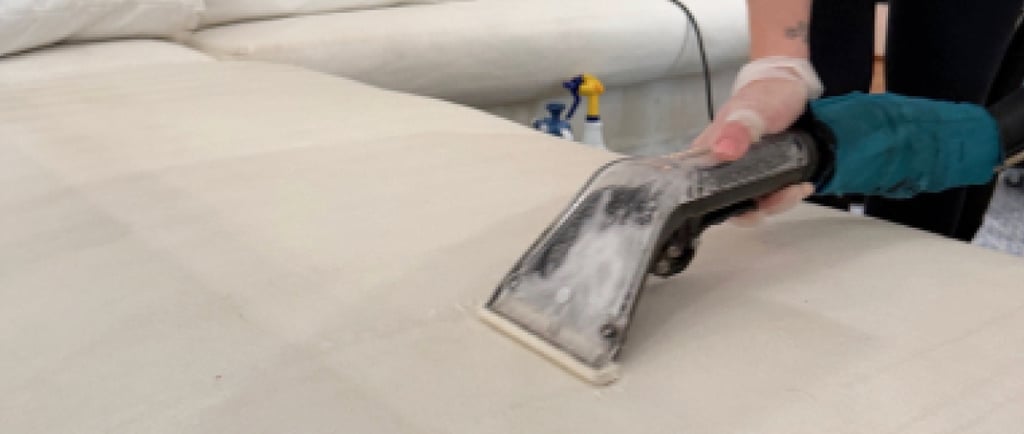
This is where professional upholstery cleaning truly separates itself from DIY attempts. When our technicians arrive for sofa cleaning or couch deep cleaning, we bring tools specifically engineered to work through the fabric and into the padding.
What Professional Equipment Actually Does
Hot water extraction (sometimes called steam upholstery cleaning) injects a controlled mixture of hot water and cleaning solution deep into the cushion layers, then immediately pulls it back out — along with the moisture, bacteria, and contaminants that were living inside. It's not just cleaning the surface; it's flushing and extracting the interior.
Truck-mounted extraction systems create far more suction power than any consumer machine. We're talking about the difference between a household vacuum and an industrial wet-vac — multiplied. This level of suction reduces the drying time from days to just a few hours.
Targeted drying tools — including high-velocity air movers placed strategically around and under cushions — push airflow into the foam structure itself, not just across the top.
Why This Matters for Your Home in Denver, CO
Denver, CO has a dry climate, which helps with surface evaporation — but it can actually be misleading. A cushion may feel dry on top while the interior foam is still holding significant moisture. Without professional extraction, that hidden dampness continues feeding mold and odor-causing bacteria long after the spill looks handled.
Our upholstery cleaning services include a post-treatment moisture check to confirm that the padding has actually dried through — not just at the surface. That's the kind of detail that makes a real difference in the long-term health of your furniture. 💪
Conclusion: This Is Bigger Than It Looks on the Surface
A liquid spill on your couch seems like a simple inconvenience — but as you now know, what happens beneath the fabric is a whole different story. Moisture moves fast, travels deep, and creates conditions for bacteria and mold that no paper towel can reach. DIY methods address the visible problem but leave the invisible one intact. And over time, that invisible problem becomes a smell, a stain that keeps coming back, or furniture that simply wears out faster than it should.
Professional upholstery cleaning isn't just about appearances — it's about fully resolving what happened inside the foam, sanitizing the padding, and restoring your furniture so it's genuinely clean, not just clean-looking.
This work requires the right equipment, the right technique, and real experience knowing how different foam densities and fabric types respond to treatment. It's not a quick job — and when it's done right, it makes a lasting difference you can feel every time you sit down. ✨
If your couch, sofa, or upholstered furniture has had a spill — recent or not-so-recent — we'd love to help. Rocky Clean - Couch Cleaning LLC specializes in professional upholstery cleaning in Denver, CO, and we're ready to get your furniture truly clean, from the fabric all the way through to the foam. 🛋️
👉 Visit us at rocky-clean.com to schedule your professional sofa cleaning today — your furniture (and your family) will thank you..
CONTACTS


2851 S Parker Rd Ste 916, Aurora, CO 80014, United States